


Subscribe
To join our mailing list and never miss an update!
With their enormous size, striking emerald-green shells, and rich golden yolks, emu eggs offer an interesting alternative to ordinary chicken eggs. A single emu egg can provide the equivalent of 8–12 chicken eggs, making it large enough to prepare breakfast for an entire family.
But their impressive size isn't the only difference. Emu eggs have a higher proportion of yolk, a different nutritional composition, and distinctive cooking characteristics. Understanding these differences can help you decide how to use emu eggs in your kitchen and what nutritional benefits they provide.
How Big Is an Emu Egg Compared to a Chicken Egg?
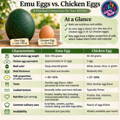
An emu egg typically weighs between 500 and 700 grams (1.1–1.5 pounds), compared with approximately 56 grams for a large chicken egg. Depending on its size, one emu egg contains approximately 400–600 grams of edible contents. This makes it equivalent to roughly 8–12 large chicken eggs.
Emu eggs also contain a much larger proportion of yolk. Yolk can account for approximately 40–45% of the edible contents, compared with 27–30% in chicken eggs. Their shells are exceptionally thick, averaging approximately 1.27 millimeters, and have a distinctive dark-green exterior that makes them popular for decorative carving after the contents are removed.

Emu Eggs vs. Chicken Eggs: Nutritional Comparison
Emu eggs contain approximately 12.9 grams of protein, 13.8 grams of fat, and 0.2 grams of carbohydrates per 100 grams of edible contents. These macronutrients provide approximately 177 calories. Chicken eggs, by comparison, contain 12.56 grams of protein, 9.51 grams of fat, 0.72 grams of carbohydrates, and 143 calories per 100 grams.
This means emu eggs contain approximately 3% more protein and 45% more fat than chicken eggs when comparing equal weights. Their higher fat concentration makes them more calorie-dense, while their protein concentrations are remarkably similar. Both contain very little carbohydrate and provide essential amino acids needed for muscle maintenance, tissue repair, and normal body functions.
An emu egg containing 500 grams of edible contents supplies approximately 64.5 grams of protein and 69 grams of fat. Divided into five equal portions, each serving provides about 12.9 grams of protein and 177 calories before adding butter, milk, cheese, or other ingredients.

How Much Cholesterol Is in an Emu Egg?
Emu eggs contain approximately 6–7.5 milligrams of dietary cholesterol per gram of edible egg, compared with 3.72 milligrams per gram in chicken eggs. Their cholesterol is concentrated in the yolk, which makes up approximately half of the edible contents of many emu eggs. The concentration varies with the proportion of yolk in each egg.
Emu eggs also have an interesting fatty-acid composition, with approximately 54% of their yolk fatty acids consisting of mono-unsaturated fats, including oleic acid, which is also abundant in olive oil. Their higher cholesterol concentration does not automatically make them less healthy than chicken eggs.
Both provide valuable nutrients, and their overall nutritional composition and serving size are more informative than cholesterol content alone.
What Vitamins and Minerals Are Found in Emu Eggs?
Emu eggs contain iron, calcium, phosphorus, magnesium, potassium, zinc, selenium, and several B vitamins. Their mineral concentrations differ from chicken eggs, with emu eggs providing higher reported amounts of certain nutrients while chicken eggs contain more of others.
Emu eggs are considerably higher in iron. Reported nutritional values place emu eggs at approximately 2.43 milligrams of iron per 100 grams, compared with 1.75 milligrams in chicken eggs. That's approximately 39% more iron, an essential mineral involved in red blood cell production and oxygen transport.
Emu eggs also provide approximately 63.9 milligrams of calcium, 198 milligrams of phosphorus, and 12.5 milligrams of magnesium per 100 grams. Calcium and phosphorus help maintain bones and teeth, while magnesium supports muscle and nerve functions.
Chicken eggs contain slightly more potassium and zinc, providing approximately 138 milligrams of potassium and 1.29 milligrams of zinc, compared with 120.7 milligrams and 0.98 milligrams in emu eggs.
Selenium concentrations are similar, with approximately 32 micrograms in emu eggs and 30.7 micrograms in chicken eggs per 100 grams. Selenium contributes to antioxidant protection and thyroid function.
Emu eggs also contain B vitamins, including thiamine (B1), riboflavin (B2), pantothenic acid (B5), and folate (B9). Published nutritional estimates report approximately 0.15 milligrams of B1, 0.24 milligrams of B2, 0.75 milligrams of B5, and 48 micrograms of folate per 100 grams. These vitamins support energy metabolism, cellular growth, and red blood cell formation.

What Types of Fat Are Found in Emu Eggs?
Emu eggs contain approximately 13.8 grams of total fat per 100 grams, with most of that fat concentrated in the yolk. Their yolk fatty acids consist of approximately 54.3% monounsaturated, 37.3% saturated, and 7.7% polyunsaturated fats. These percentages describe the fatty-acid composition of the yolk fat rather than the entire egg.
Oleic acid, the same monounsaturated fatty acid found abundantly in olive oil, is a major component of emu egg yolk fat. Palmitic acid is one of the predominant saturated fatty acids.
Although emu eggs contain more total fat than chicken eggs, monounsaturated fatty acids represent the largest portion of their measured yolk fatty acids.
What Do Emu Eggs Taste Like?
Emu eggs taste similar to chicken eggs but are generally described as richer, creamier, and slightly more "buttery". Their greater yolk proportion contributes to this richness, particularly when scrambled or prepared as an omelet. They do not have the strong gamey flavor that some people might expect from an unusual poultry species.
The difference is most noticeable when eggs are the primary ingredient. Scrambled emu eggs have a rich flavor, while custards and quiches benefit from their higher yolk content. In heavily seasoned dishes or baked goods, their flavor is less distinguishable from chicken eggs.
Trending Articles



Do Emu Eggs Have a Different Texture?
Emu eggs have a thicker consistency when raw and produce a softer texture when cooked. Whole raw emu egg can be approximately six times more viscous than chicken egg under comparable testing conditions, while its yolk can be approximately nine times more viscous.
When heated, emu egg proteins form softer structures than chicken egg proteins. This produces a more delicate consistency in cooked eggs and can create a softer crumb in cakes. Their greater proportion of yolk also contributes richness to custards, quiches, and other egg-based recipes.
How Do You Substitute Emu Eggs for Chicken Eggs?
When cooking with emu eggs. the simplest method is to substitute emu egg by weight. Use 50 grams of thoroughly beaten emu egg for every large chicken egg required in a recipe. A recipe calling for four chicken eggs, for example, requires 200 grams of beaten emu egg.
Crack the emu egg into a clean bowl and whisk until the yolk and white are completely combined. Use a kitchen scale to measure the quantity needed, rather than relying on the size of the shell. This provides a practical starting substitution for scrambled eggs, omelets, frittatas, muffins, and cakes.
The higher yolk proportion can produce richer, softer results in baked goods. For recipes requiring separately whipped egg whites, such as meringues and angel food cakes, chicken egg whites are the more predictable choice because emu egg proteins behave differently when whipped.

What Are the Best Ways to Cook Emu Eggs?
Emu eggs work particularly well in family-sized scrambled eggs, omelets, frittatas, quiches, and baked goods. Their large size makes them convenient for recipes requiring several eggs, while their high yolk content contributes richness and a tender texture.
For scrambled emu eggs, whisk 400–500 grams of egg until thoroughly combined. Pour into a lightly buttered skillet over medium-low heat and gently stir until fully set. Season with salt, pepper, and fresh herbs for approximately four to six servings.
For an emu egg frittata, combine 300 grams of beaten emu egg with ½ cup of milk, 1 cup of cooked vegetables, and ½ cup of shredded cheese. Pour into a greased 9-inch oven-safe skillet or baking dish and bake at 350°F until the center reaches 160°F, beginning to check after approximately 20 minutes. Spinach, mushrooms, onions, and cooked breakfast sausage all make excellent additions.
Emu eggs are also useful in cakes and muffins. Replace each large chicken egg with 50 grams of beaten emu egg, following the recipe's remaining ingredient quantities and baking instructions. Their different protein structure can produce a softer finished texture, particularly in cakes.

How Do You Crack Open an Emu Egg?

Why Aren't Emu Eggs Commonly Sold in Grocery Stores?
THE TAKEAWAY
Trending Products
Copyright©2026 All rights reserved. We love to have you share our article as long as you include a direct link to this page. This article or any portion thereof , including all images, may not be reproduced or used in any manner whatsoever without the express written permission of Gypsy Shoals Farm.